Thursday, August 4, 2011

E-learning x traditional classroom


In traditional course:

1) the classes are focused on the teacher

2) the learning process is 'passive'

3) students who are more outgoing participate more than quiet students

4) teachers use computer as a tool, but it is not the key element.


Online Courses:

1) totally focused on the student,

2) instructors have to guide the student, not only pass the knowledge on

3) even shy students talk because the classes have to be 100% 'active'

4) with the use of the computers, students can explore different kinds of resource and the teacher uses a variety of learning methods.


Monday, October 11, 2010

National Geographic video: CIA experiments

How would you feel if you found out that you were part of a CIA experiment?
How would you feel if you knew your mind was being controlled?
Can tests be done without one's consent?


At the height of the Cold War, the CIA launched a highly classified
, top secret reserch program taht exposed Americans to biological agents, hallucinogenic drugs and psychological techniques aimed at mastering the art of mind control. Entire cities in America were contaminated with bacteria, exposing millions to germ warfare. NGC's CIA Secret Experiments examines what happened.

Watch the video: CIA Experiments


Wednesday, September 8, 2010

How much water can you save?

Take a water tour with National Geographic through your home, garden, diet, energy use, and your stuff!

Here is the link: Water Footprint Calculator

Enjoy it!

Friday, July 2, 2010

Curious facts

So, here are some curious facts:


A giraffe can clean its own ear with its 21 inch tongue.


Months that begin on Sunday will always have a Friday, 13th.


You are born with 300 bones, but by the time you become an adult you have only 206.


The elephant is the only mammal that can't jump!


Wednesday, June 9, 2010

Sinkhole

How does it happen?

A sinkhole happens when water erodes solid bedrock, carving an underground cavity that can then collapse.


Sinkhole in
Guatemala

Heavy rains from tropical storm must have triggered the collapse of this huge sink hole.
Much of Guatemala's city rests a top a layer of loose, gravelly volcanic pumice.
Some geologists say that leaking pipe - not nature - must have
created the recent sinkhole.


Sinkhole in Florida

The sinkhole in Winter Park, Florida, opened in 1981 underneath the city's public swimming pool.


Sinkhole in Belize

Sinkhole can happen anywhere water can erode a vertical channel that connects to a horizontal drain, a situation that allows a column of solid material to wash away, Missouri State's Gouzie explained.


Sinkhole in Mexico

Sinkholes occuring at sea level will fill up as high as the water table, creating a famous clear blue pool. This one was used by the Maya royalty for both relaxation and ritual sacrificies.
(read: Mysteries of Sacrificial Maya Blue Pigment Solved)


June,04th2010


Friday, April 30, 2010

Hubble's mytic moutain


A colorful, craggy colunm of dust and gas dubbed the Mystic Mountain stars in the newest picture from the Hubble Sapace Telescope. Released on April, 23 as part of celebrations for Hubble's 20th anniversary, the picture highlights the result of star birth in the Carina nebula.
Hot young stars are constantly emiting radiation and charged particles that sculpt the cosmic cloud from the inside. Columns like this one are regions of matter dense enough to stand up to stellar erosion.

Published in April 27, 2010
National Geographic


Monday, March 15, 2010

False Friends (Portuguese,English)


What are false friends?

False friends are words which have similar writing, or even identical in both distinct languages, but their meanings are different.
Take as an example the word exquisite. In portuguese it would easily be misunderstood as exquisito(weird), when it really means requintado, refinado.
The most appropriate denomination of false friends in portuguese would be 'cognatos de sentido diferente'. Cognates are words which contain the same root as another language, but as languages developed apart their meanings may differ.

Here are some of them:

English Portuguese
actual verdadeiro, real
cobra Naja(uma especie de cobra)
eventually finalmente, no final, por fim
legend lenda
library biblioteca
pretend fingir
realize perceber


There is a pocketbook you can buy to get you started:
Easy Way False Friends by José Roberto A. Igreja

Thursday, February 25, 2010


In 2005 the Clinton Foundation and the American Heart Association launched the Alliance for a Healthier Generation. Their mission is to eliminate childhood obesity and inspire all young people in the US to develop life long healthy habits of eating and exercises.

25 million young people are overweight or ceboming overweight in the US.

In this video you'll see Bill Clinton meeting Justin DeParis, a
Youth Advisory Board member of the Alliance for a Healthier Generation, to discuss the growing number of overweight young people.

For more information go to Alliance for Healthier Generation

Wednesday, February 24, 2010

Acronym and Initialism


Acronyms and Initialism are abbreviations that are formed using the initial components in phrase or name. These components may be individual letters (as in CEO) or parts of words (as in Benelux). There is no universal agreement on the precise definition of the various terms, nor on written usage.

While the word abbreviation refers to any shortened form of a word or phrase, some have used initialism to refer to an abbreviation formed simply from a string of initials. In 1943, Bell Laboratories coined the term acronym as the name for a word created from the first letters of each word in aseries of words (such as sonar, created from sound navigation and ranging).

Examples

Pronounced as a word, containing only initial letters

AIDS: acquired immune deficiency syndrome
ASBO: anti-social behavior order
NATO: North Atlantic Treaty Organization
Scuba: self-contained underwater breathing apparatus

Pronounced as word, containing non-initial letters

amphetamine: alpha-methyl-phenethylamine
Gestapo: Geheime Staatspolizei (secret state police)
Interpol: International Criminal Police Organization
Radar: radio detection and ranging

Pronounced as a word or names of letters, dependind on speaker or context

FAQ: frequently asked questions
IRA: .(1) Irish Republican Army pronounced as separated letters
.(2) Individual Retirement Account pronounced as a word


Thursday, February 11, 2010

BBC Brasil - Aprenda Inglês


Hello Everyone!


Here is one more webpage you can use as a tool for your learning process.


BBC Brasil - Aprenda Inglês


Here you'll find:


* pronunciation tips

* news (audio and script)

and much more!


Enjoy it!

Monday, February 1, 2010

Forvo

A new pronunciation guide.
All the words in the world, pronounced.

forvo.com


Google Wave

What is a wave?

A wave is equal parts conversation and document. People can communicate and work together with richly formatted text, photos, videos, maps, and more.

A wave is shared. Any participant can reply anywhere in the message, edit the content and add participants at any point in the process. Then playback lets anyone rewind the wave to see who said what and when.

A wave is live. With live transmission as you type, participants on a wave can have faster conversations, see edits and interact with extensions in real-time.


Thursday, April 9, 2009

Help end hunger


If you think you're doing not much to help people around you...
If you feel you should be doing more than just wake-eat-work-eat-watchTV-sleep....

Here is a way to help people around the world.

Free Rice

You can play many subjects: math, English, arts, French, etc...
Playing you help donating food for those who are hungry.

FreeRice began October 7th, 2007, donating just 830 grains of rice that day. Now totals surpassed 62 billion grains donated. Advertisers on the site pay for the rice while the United Nations World Food Program (WFP) delivers it.


Enjoy it!!!

Wednesday, April 1, 2009

The natural flow of English


by Maria Hruschak


When a Native English Speaker speaks, only select words are stressed, while others are spoken quickly, or glided over.

Why?

English is a stressed language. Unlike Chinese, French or Italian, which devotes equal attention to each word, English stresses only the content words and glides over the 'helpers'.

Nouns, principal verbs, adjectives and adverbs are all content words.

Pronouns, articles, auxiliary verbs, prepositions, and conjunctions are the 'helper' words.

Ex: They will come on Friday.
Emphasis is placed on the bold words.

This is a tricky concept for a Native English Teacher to get across to a new student in English.

Here is a quick way to see some results:

Read any paragraph in English. Stress each and every syllable. (You will notice that the sound is almost robotic).

Next, read the same paragraph, only this time stress only the content words, and glide over the others. If you need to, underline the content words first. Don't get too caught up in which is which if you are not sure.

The point is to become familiar with the flow of English.
Using this technique will make it easier for people to understand you.

Tuesday, March 24, 2009

Phrasal verbs


Multi-word verbs, phrasal verbs ou prepositional verbs são locuções em inglês compostas de um verbo e uma preposição ou um advérbio. Ocorrem predominantemente com verbos de origem anglo-saxônica e são característicos da língua. Multi-word verbs estão presentes no inglês desde antes dos tempos de Shakespeare, e traduzem um tom de linguagem informal, emotivo, podendo freqüentemente ser classificados como gíria.
Os verbos preposicionados representam um sério e persistente problema ao nível de vocabulário. Devem ser encarados como vocábulos independentes dos elementos que os compõem e portanto como uma palavra nova a ser assimilada, porque normalmente a adição de uma preposição ao verbo altera substancialmente o seu significado original. Cada um torna-se um vocábulo novo a ser assimilado. Embora o número de verbos preposicionados em inglês seja praticamente ilimitado, o aprendiz de inglês que dominar cerca de 20 ou 30 dos mais comuns, dos que ocorrem com mais freqüência, pode dar-se por satisfeito numa etapa inicial de seu aprendizado.

Examples:

act like (inseparable): behave in a way that's like .....
"What's wrong with Bob? He's acting like an idiot."

act up
(no object): not work properly (for machines)
" I think I should take my car to the garage. It's acting up since early morning."


Fonte: http://www.sk.com.br/sk-twow.html

Tuesday, March 17, 2009

English facts


Here are some random English facts for all you lexiophiles (lovers of words):


The word 'queue' is the only word in the English language that is still pronounced the same way when the last four letters are removed.


No word in the English language rhymes with 'month,' 'silver,' 'purple,' or 'orange.'


The words 'assassination' and 'bump' were invented by Shakespeare.


China has more English speakers than the United States.


The plural of mouse, the rodent, is mice. The plural of mouse, the computer hardware device, is mouses.


Widow is the only female form in the English language that is shorter than its corresponding male term (widower).


The longest one-syllable word in the English language is 'screeched.'


The letter most in use in the English language is 'E' and the letter 'Q' is least used.


Pinocchio is Italian for 'pine head.'


The word 'lethologica' describes the state of not being able to remember the word you want.


The phrase 'sleep tight' originated when mattresses were set upon ropes woven through the bed frame. To remedy sagging ropes, one would use a bed key to tighten the rope.


The word 'set' has more definitions than any other word in the English language.


In Chinese, the words for crisis and opportunity are the same.


There is no synonym for 'thesaurus.'


The first word spoken on the moon was 'okay.'


The name of all the continents end with the same letter that they start with.


Karaoke means 'empty orchestra' in Japanese.


The word 'nerd' was first coined by Dr. Seuss in 'If I ran the Zoo'.


And one not so related to English, but mind blowing none-the-less: If the population of China walked past you in single file, the line would never end because of the rate of reproduction.


For more English facts visit Oddities and Interesting Things.

Just for laughs


I was checking some websites from other English teachers and look what I found!!!!


Kids are quick.


Teacher: Heather, go to the map and find North America.
Heather: Here it is.
Teacher: Good. Now class, who can tell me who discovered America?
Class: Heather


Teacher: Thomas, how do you spell crocodile?
Thomas: k-r-o-k-o-d-i-a-l
Teacher: No, that's not right.
Thomas: Maybe it's wrong, but you asked me how I spell it.


Teacher: Heather, what do you call a person who keeps on talking when people are no longer interested?
Heather: A teacher.


Teacher: Jenna, name one important thing that we have today that we didn't have ten years ago.
Jenna: Me!

Language vocabulary


Hi guys,

Last week I was looking for something extra to do in class and accidentally I found this website, which is really useful to anyone.


It's: Language Guide


It contains general vocabulary with audio and grammar explanations as well.

Cheers,

Dani

Monday, March 2, 2009

Língua Inglesa - onde tudo começou

Poderíamos comparar o idioma inglês a uma colcha feita de retalhos de tecidos de origens mais diversas


Origem: através dos dialetos germânicos falados pelos anglos e pelos saxões

A história - dividida em 3 períodos

Old English (500 - 1100 A.D.): vários dialetos das línguas indo-européias tornam-se grupos de línguas distintos, sendo um desses o celta; os dialetos celtas eram funcionais e com o cristianismo em 432 A.D. o vocabulário greco-latino expandiu a linguagem dos conceitos abstratos.

Middle English (1100 - 1500 A.D.): a batalha de Hastings em 1066 alterou o rumo da língua inglesa e por 300 anos a língua usada pela aristocracia na Inglaterra foi o francês; Middle English caracterizou-se pela gradual perda de declinações, pela neutralização e perda de vogais em final de palavras e pela influência do GREAT VOWEL SHIFT.
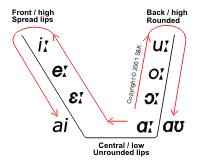


****** Até o século XV o som das vogais era bastante semelhante as demais línguas ocidentais, inclusive o português.


Modern English (1500 - hoje): representou o período de padronização da língua; a estrutura gramatical incorporou conceitos das línguas latinas; o idioma escrito quase não sofreu alterações, enquanto sua pronúncia (influenciada pelo GREAT VOWEL SHIFT) não acompanhou as reformas ortográficas.


Séculos XVI e XVII: incorporação do verbo auxiliar DO


Shakespeare na história

Shakespeare representou uma forte influência no desenvolvimento de uma linguagem literária, ele transformou substantivos em verbos, verbos em adjetivos, bem como a livre adição de prefixos e sufixos.

Legal, né?
=/

Inglês Americano x Inglês britânico

O contato com a realidade de um novo ambiente com culturas indígenas nativas e com o espanhol provocou o desenvolvimento de vocabulário diverso do inglês britânico.


Fonte: http://www.sk.com.br/sk-enhis.html acessado em Jan/2009

Wednesday, January 14, 2009

Simple Present

Hello there,

So... here is a little explanation about simple present.
I hope it can be useful to you.

SIMPLE PRESENT

1 general time: It always rains in November.
We often use the simple present to talk about permanent situations(1), or about things that happen regularly repeatedly or all the time(2).
Alice works for an insurance company. (1)
I play tennis every Wednesday. (2)


2 not used for things happening just around the present
We do not usually use the simple present to talk about temporary situations or actions that are only going on around the present. Compare:
It snows in January. It is snowing (not – Look! It snows!)


3 non-progressive verbs
However, the simple present is used for this ‘around the present’ meaning with verbs that do not have progressive forms.
I like chocolate. (not - I am liking…) I believe you. (not – I am believing…)


4 Series of events: demonstrations, commentaries, instructions, stories
When we talk about series of completed actions and events, we often use the simple present. This happens, for example, in demonstrations, commentaries, instructions and present-tense stories.
How do I get to the station? You go straight on the traffic lights, then you turn left,…


SWAN, Michael. Practical English Usage. 3rd Ed. 2005-2009